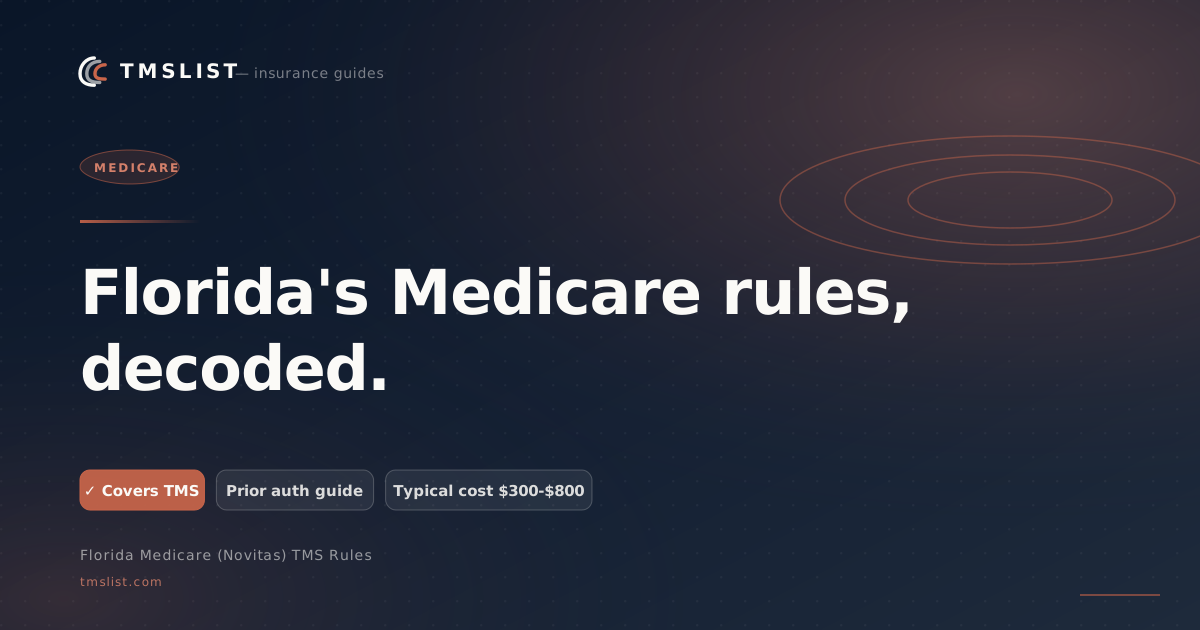
Does Medicare cover TMS in Florida?
Yes. Medicare Part B covers TMS for treatment-resistant depression in Florida. The process works the same as in other states, but Florida has a layer of complexity: the state is split between two Medicare Administrative Contractors (MACs), each with its own submission portals and some regional policy nuances.
If you have Medicare and depression that hasn’t responded to medication, TMS is a covered option. The main steps are the same — diagnosis confirmation, documented medication failures, prior authorization, physician oversight — but the paperwork goes to your regional MAC.
Understanding Novitas Solutions (the Medicare Administrative Contractor for most of Florida)
Medicare doesn’t process claims directly. It contracts that work out to regional MACs. For most of Florida, that’s Novitas Solutions, which administers Jurisdiction H (JH). That includes the vast majority of Florida counties, including all major metro areas outside a few FCSO counties.
What Novitas does:
- Reviews and approves (or denies) TMS prior authorization requests
- Processes Medicare Part B claims for its jurisdiction
- Publishes local coverage determinations (LCDs) that define what’s covered and under what conditions
- Handles appeals for claims within its region
Which Florida counties does Novitas cover? Most of them — including the entire panhandle, north Florida, the Orlando metro area, and much of central Florida. If you’re in the Jacksonville, Tampa, Orlando, Gainesville, Tallahassee, or Pensacola areas, you’re likely dealing with Novitas.
First Coast Service Options (FCSO) handles a separate portion of Florida, primarily some counties in the Jacksonville area and a few surrounding regions. If your clinic is in an FCSO county, your prior auth goes to them instead. Your clinic knows which MAC serves your address — just ask.
For TMS coverage purposes, both MACs follow the same Medicare national coverage guidelines for treatment-resistant depression, but their documentation requirements and submission portals differ.
Novitas-specific TMS coverage criteria
To get TMS approved through Novitas, you’ll need to meet criteria that align with Medicare national coverage guidelines plus any Novitas-specific documentation standards:
- A confirmed diagnosis of Major Depressive Disorder (MDD) from a psychiatrist — not a primary care provider
- 2-4 failed antidepressant trials from at least two different drug classes, each taken at an adequate dose for 6-8 weeks
- Documented treatment resistance — meaning you gave each medication a fair shot and it didn’t work
- Prior authorization submitted by your TMS clinic to Novitas Solutions
- A supervising physician who orders and monitors your TMS treatment
- Current PHQ-9 or equivalent depression scale score showing moderate-to-severe depression
Novitas may also want to see records of any psychotherapy trials. If you’ve done CBT or other therapy without adequate improvement, document that too.
What documentation Novitas needs
Your TMS clinic typically assembles and submits this, but it’s helpful to know what’s in the package:
- Psychiatric evaluation confirming MDD diagnosis with supporting clinical notes
- Medication history listing all antidepressant trials — drug name, dose, duration, why it was stopped
- PHQ-9 or MADRS score from a recent evaluation
- Treatment plan including the TMS protocol being proposed (number of sessions, frequency, intensity)
- Physician order signed by the supervising psychiatrist or physician
- Prior auth form completed through Novitas’ provider portal
Clinics that do this regularly know exactly what Novitas expects. A clinic that hasn’t submitted many Medicare TMS requests may need extra guidance — which is another reason to use a clinic with Medicare TMS experience.
How Florida’s Medicare TMS decisions compare to other states
Florida’s Medicare TMS landscape tracks closely with the national picture, with a few state-specific wrinkles:
- Dual MAC system: Most states have one MAC. Florida has two. This means your approval process depends on your county. It’s not complicated — your clinic handles it — but it means you can’t assume one MAC’s timeline or experience applies to you.
- Large seasonal population: Florida’s snowbird and seasonal resident population is massive. Medicare TMS providers in Florida are accustomed to coordinating care for patients who split their time between Florida and other states.
- Strong TMS provider network: Major metro areas (Miami, Tampa, Orlando, Jacksonville) have multiple TMS clinics that accept Medicare, making access better than in many rural states.
- Wait times: Florida’s larger TMS clinics may have longer wait times for initial consultations — sometimes 2-6 weeks. Plan ahead if you’re traveling from out of state for treatment.
Compared to states with restrictive MAC policies, Florida Medicare patients generally have a smoother path to TMS coverage. The criteria are clear and well-established.
Finding TMS providers in Florida who accept Medicare
Use our directory and filter by Florida and “Medicare.” A few things to verify before scheduling:
- Ask if they accept Medicare assignment. Some clinics don’t, which means they can charge above Medicare’s approved rate and pass the difference to you.
- Ask which MAC they submit to. Especially in border counties, confirm whether they’re billing through Novitas or FCSO.
- Ask about their Medicare TMS volume. A clinic that does 50+ Medicare TMS cases a year knows the prior auth process cold. A clinic doing it for the first time may face delays.
Florida’s major metro areas have solid options. Rural counties may require travel to the nearest city — worth factoring into your logistics if you’re doing a daily commute for 4-6 weeks.
Florida-specific considerations (snowbird patients, seasonal residency)
If you split your time between Florida and another state, a few things to keep in mind:
- Your Medicare coverage follows you. Original Medicare works the same anywhere in the U.S. — no network restrictions, no state boundaries.
- Continuity of care: If your TMS treatment spans two states (say, you start in New York and continue in Florida for the winter), try to keep the same TMS provider or at least the same TMS practice network. Switching clinics mid-treatment can require a new prior auth.
- Timing your authorization: If you’re in Florida only part of the year, plan your TMS course to fit your stay. A full acute protocol is 20-36 sessions over 4-8 weeks. You need to be here for that window.
- Medigap in two states: If you have a Medigap supplement plan, it works anywhere Medicare does. No network issues.
- Medicare Advantage plans: If you’re on a Medicare Advantage plan, check whether your plan’s Florida network has TMS providers. Some MA plans have narrower networks in seasonal states.
Related Insurance Guides
Ready to Explore Your Options?
Browse verified TMS providers, compare clinics, and find the right treatment for your situation.
Step-by-Step TMS Approval Process
Call the number on your Medicare card or 1-800-MEDICARE. Ask specifically about TMS (CPT 90867-90869) coverage for treatment-resistant depression. Get a reference number and note the representative's name.
Gather your MDD psychiatric evaluation, complete medication history (names, doses, durations, outcomes for each trial), current PHQ-9 score, and any therapy records. Your psychiatrist's office can compile this.
Use our clinic directory to find TMS providers who accept Medicare. Confirm they accept Medicare assignment and know whether they bill through Novitas or FCSO.
Your TMS clinic submits the prior auth package to Novitas Solutions (JH) or First Coast Service Options (FCSO) depending on your county. Approval typically takes 5-15 business days.
Once approved, your TMS clinic schedules your acute protocol (typically 5 sessions per week for 4-8 weeks). Medicare Part B covers 80% of the approved amount — you pay 20% after your deductible.
What If You’re Denied?
Don't give up after a denial
TMS denial overturn rates are 60-70% on appeal. Steps to take:
- Request a peer-to-peer review — your psychiatrist talks directly to Novitas' or FCSO's medical director to clarify clinical necessity
- Submit additional documentation addressing the specific denial reason — most commonly missing medication trial details or incomplete PHQ-9 scores
- File a formal appeal with Medicare through the Redetermination Request process
- Seek assistance from a patient advocate at your TMS clinic — clinics experienced with Medicare TMS know how to build a winning appeal
For more details, see our Prior Authorization Guide and Denied Coverage Appeals guide.
Explore TMS List
Treatments & Conditions
Insurance & Cost
-
 Blue Cross Blue Shield Coverage
 -
 Aetna TMS Coverage
 -
 Cigna TMS Coverage
 - TMS Cost Guide
- TMS Cost Calculator
TMS Specialists
- Tamara Movsesova — Washington, DC
- Michael Mitchell — Tallahassee, FL
- Katie Mann — Tallahassee, FL
- Dr. Robert Bota, MD — Costa Mesa, CA