The science
behind TMS.
Explore the mechanism, brain anatomy, treatment protocols, and the patient journey — written for clinicians and patients alike.
How TMS Works
Transcranial magnetic stimulation uses focused electromagnetic pulses to selectively activate or inhibit specific brain regions — without surgery, sedation, or systemic side effects.
Magnetic Pulse
A coil placed on the scalp generates a brief, powerful magnetic field — similar to an MRI — lasting about 200 microseconds per pulse.
Induces Current
The magnetic field passes through the skull painlessly and induces a small electrical current in the underlying cortical neurons.
Neurons Fire
The induced current causes target neurons to depolarize and fire, releasing neurotransmitters and modulating downstream brain networks.
Network Effect
Repeated sessions strengthen synaptic connections, normalize dysfunctional circuits, and produce lasting changes in mood and cognition.
Try the simulator
Adjust the coil parameters and watch the magnetic field penetrate the cortex. Pick a clinical protocol or design your own — the readouts update live.
10 Hz, 120% MT — most-studied depression protocol. Try moving the sliders — watch how depth of penetration and the motor-evoked potential change in real time.
At 120% MT, the field reaches ~1.7 cm below the scalp — enough to penetrate the cortex comfortably. Pulses fire at 10 Hz, depolarising pyramidal neurons in layer II/III each cycle.
Interactive Brain Atlas
Explore the brain regions targeted by TMS for each FDA-cleared condition. Click any region to see protocols and outcome data — toggle 'Connect to simulator' above to update the coil target.
Treatment Protocols
Compare the major TMS protocols used in clinical practice — frequency, session count, target conditions.
Protocol Academy
Six primary TMS protocols used clinically. Each targets different brain regions with distinct stimulation parameters. Click a card for the full breakdown.
High-Frequency rTMS (10Hz)
Frequency
10 Hz
Intensity
120% MT
Pulses
3,000 per session
Duration
37 min/session
Treatment Schedule
36 total sessions · 1
Indication
Major Depression
Advantages
- +Most studied protocol
- +Wide insurance coverage
- +Well-understood safety profile
Considerations
- −Daily visits for 6+ weeks
- −Moderate dropout rate (~20%)
The Patient Journey
From first consultation to lasting results — what to expect at every stage of a 6-week course.
- 1Week 0
Consultation
Psychiatric evaluation, diagnosis confirmation, baseline PHQ-9 / HAM-D scores, and insurance pre-authorization.
- 2Day 1
Motor Threshold Mapping
Calibration session — coil placement is fine-tuned and treatment intensity (typically 80–120% MT) is set.
- 3Weeks 1–2
Early Treatment
Daily 20–37 minute sessions, Mon–Fri. You sit in a recliner; mild scalp tapping is normal. Resume normal activity immediately.
- 4Weeks 3–5
Building Response
First signs of improvement — better sleep, more energy, lifting mood. Side effects diminish.
- 5Week 6
Consolidation
Final sessions. PHQ-9 reassessed and often significantly reduced. Discussion of maintenance plan.
- 6Month 2+
Maintenance
Optional periodic sessions to sustain gains. Long-term outcome follow-up at 1, 3, and 6 months.
Continue Learning
Deeper-dives into the most-asked TMS topics.
How rTMS Works
The mechanism behind repetitive transcranial magnetic stimulation.
Deep TMS
BrainsWay H-coil technology and what it reaches that figure-8 coils can't.
Theta Burst (TBS)
The 3-minute condensed protocol — same efficacy as standard rTMS.
SAINT Protocol
Stanford's 5-day accelerated course with 79% remission in trials.
Neuroplasticity & TMS
How TMS rewires brain circuits — fMRI evidence and LTP science.
FDA Clearance History
Timeline from 2008 to present — devices, indications, and trial data.
Ready to take the next step?
The science is clear. Find out if TMS therapy is right for your situation.
Explore TMS List
Treatments & Conditions
Insurance & Cost
-
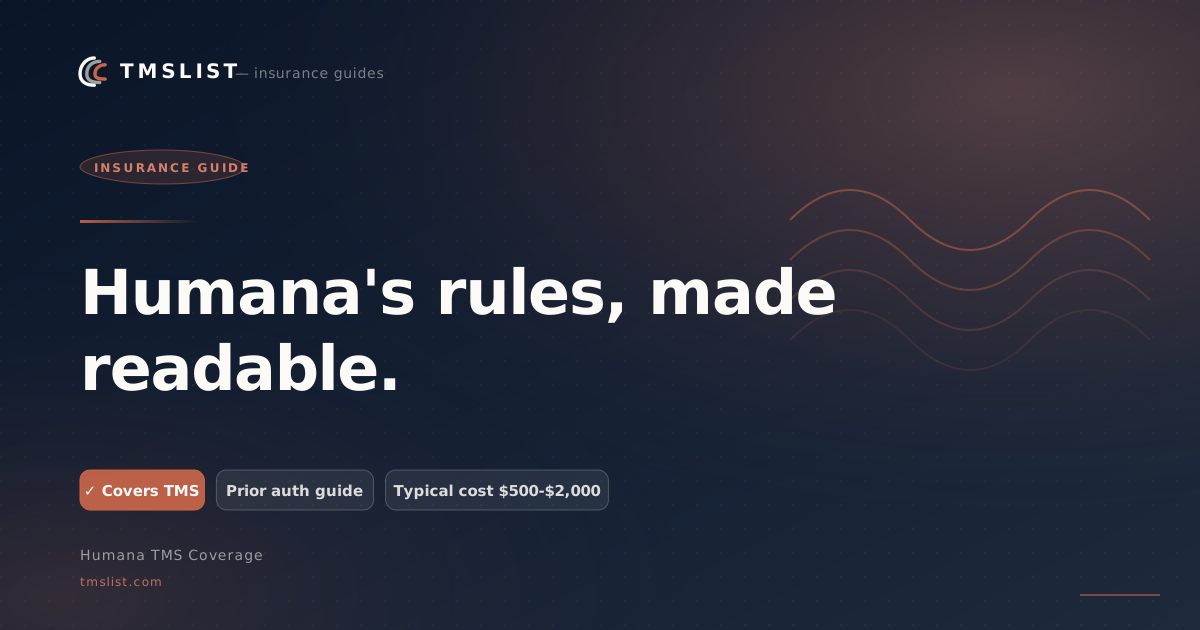 Humana TMS Coverage
 -
 Medicare Coverage for TMS
 -
 Medicaid Coverage for TMS
 - TMS Cost Guide
- TMS Cost Calculator
TMS Specialists
- Dr. David Sikowitz — Tinton Falls, NJ
- Gregory Hutton — Tallahassee, FL
- Eric Nicola — Tallahassee, FL
- Anthony Mele — Newport Beach, CA