TMS vs ECT vs Medication
Compare TMS vs ECT vs antidepressants.
Clinical Efficacy
Response and remission rates in treatment-resistant depression
45-55% response
Non-inferior to medications in TRD. iTBS equivalent to standard rTMS.
70-90% response
Highest efficacy of all treatments. Gold standard for severe TRD.
35-50% response
First-line effectiveness. Diminishes with each failed trial.
Speed of Response
How quickly patients notice symptom improvement
3-4 weeks
Gradual improvement. Response typically by week 3-4.
1-2 weeks
Rapid response, often within days. ECT is the fastest-acting treatment.
4-8 weeks
Slow onset. Must wait 4-6 weeks to assess efficacy at each dose.
Side Effect Burden
Short and long-term side effects profile
Mild, transient
Scalp discomfort, mild headache. No cognitive effects.
Significant short-term
Memory disruption (anterograde/retrograde), confusion, anesthesia risk.
Moderate, chronic
Sexual dysfunction, weight gain, nausea, discontinuation syndrome.
Time Commitment
Duration and frequency of treatment course
36 sessions / 6 weeks
Daily weekday visits, 20-37 min per session.
6-12 treatments
Fewer sessions but requires anesthesia, fasting, escort. Slower return to normal activity.
Daily, ongoing
Take one pill per day. Can be integrated into normal life.
Cognitive Impact
Effect on memory, focus, and mental function
No negative effect
May improve cognitive function as depression lifts. No memory loss.
Significant impairment
Retrograde amnesia can span months. May affect working memory for weeks.
Minimal impact
Some anticholinergic effects possible. Generally cognitively neutral.
Invasiveness
How physically invasive is the treatment
Non-invasive
Fully awake, outpatient. Coil placed on scalp. No anesthesia.
Highly invasive
General anesthesia required. Muscle relaxants. Seizure induced under supervision.
Non-invasive
Oral medication. No procedures required.
Maintenance Required
Long-term maintenance after initial treatment
Tapering + optional maintenance
18% relapse at 6 months without maintenance. Booster sessions available.
Maintenance ECT often needed
Relapse rate ~50% without maintenance. Monthly or biweekly continuation.
Continuous medication
Discontinuation leads to high relapse rates. Long-term use often necessary.
Cost (Without Insurance)
Estimated out-of-pocket cost for full treatment course
$6,000–$12,000
~$200-350/session × 36 sessions. May be partially covered.
$3,000–$10,000
Anesthesia + facility + physician fees. Typically covered for severe TRD.
$20–$200/month
Generic SSRIs $10-30/mo. Newer agents $100-300/mo. Ongoing cost.
When to choose TMS over ECT
- • You want to avoid anesthesia and memory disruption
- • You can commit to daily visits for 6 weeks
- • You've had a good response to TMS before
- • You're elderly or have cardiac concerns
- • You want to remain fully functional during treatment
When to choose ECT over TMS
- • Acute suicidality or severe psychotic depression
- • Catatonia or severe psychomotor retardation
- • Failed multiple medication trials AND TMS
- • You need rapid response (weeks not months)
- • You're under psychiatric hospitalization
References & Sources
• Kellner CH et al. ECT handbook 4th ed.
• Lefter B et al. TMS vs ECT meta-analysis, JECT
• McIntyre JS et al. APA Treatment Guidelines MDD
• Novartis MAOI/SNRI clinical trial data
• Cleeremans A et al. TMS neuroplasticity NEJM
• Rosenquist PB et al. Maintenance ECT JECT
Explore TMS List
Treatments & Conditions
Insurance & Cost
-
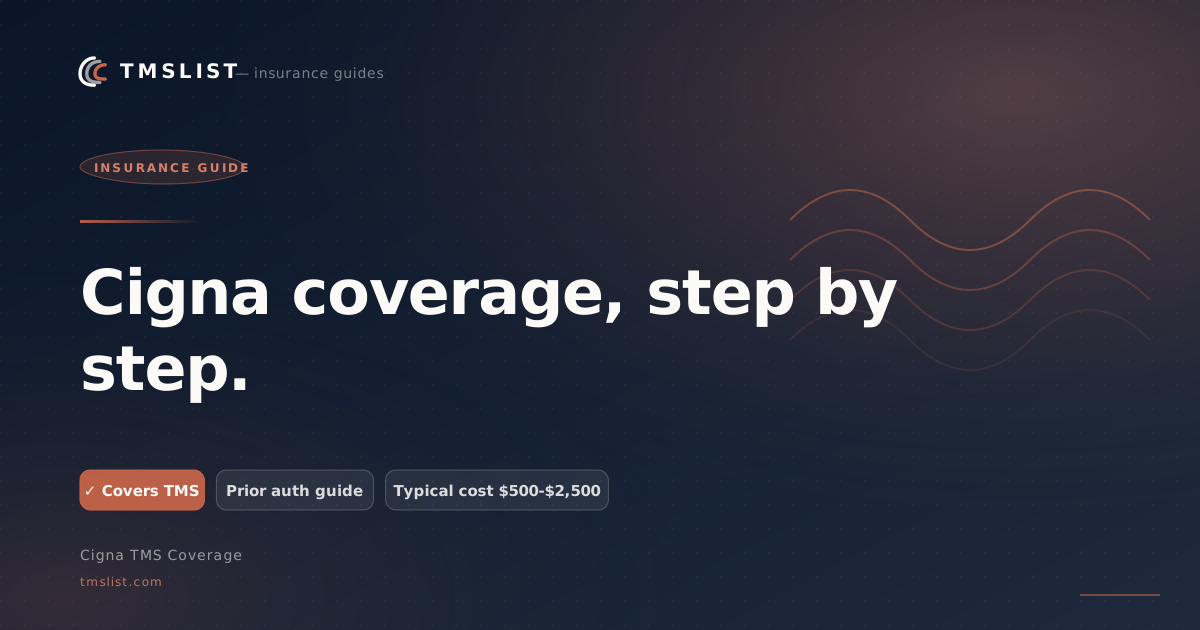 Cigna TMS Coverage
 -
 UnitedHealthcare Coverage
 -
 Kaiser Permanente Coverage
 - TMS Cost Guide
- TMS Cost Calculator
TMS Specialists
- Jack Castro — Wilmington, DE
- Kelly Sunshine — Tallahassee, FL
- Edgar Castillo-Armas — Fresno, CA
- Mary Berst — Newport Beach, CA